

The first time, most people arrive expecting the Full Moon Party version of the island. The ferry pulls into Thong Sala, the bags come off, and somewhere between the pier and the guesthouse they notice something that wasn’t in the plan: a kite in the sky, pulling a rider across flat water with the kind of effortless speed that makes you stop walking and just watch. By the following morning, half of them are on the beach asking questions.
That moment plays out multiple times each high season. Koh Phangan is globally famous for one thing and almost entirely unknown for another. And for riders who care about wind sports, that obscurity is currently the island’s most significant asset. No crowds, no competition for water space, no overcrowded learning zones.
Water that actually works for learning and riding
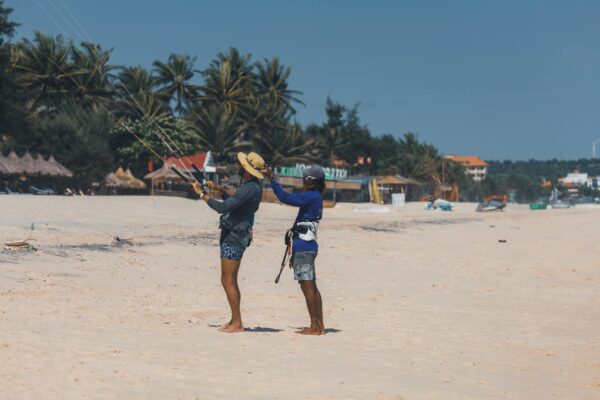
The lagoon at Thong Sala Beach is a combination that’s harder to find in Southeast Asia than it looks on a map. Sheltered from open ocean swell, shallow across a wide sandy bay, with a bottom that stays soft throughout the riding area. For first-timers getting their first sessions on a foil board or learning kite control for the first time, the practical value of shallow water is difficult to overstate. Falls don’t cost you 15 minutes of swimming. You stand up, reposition, and go again.
For experienced riders the same geography offers something different: clean, flat water with enough fetch to build real speed, and open space to link turns without navigating around other people or boat traffic. Unlike busier tourist beaches in the region, the riding zone here stays clear during sessions. That’s not an accident of timing — it’s consistent across the high season window.
The Gulf of Thailand keeps water temperatures above 28°C through the main riding months. No wetsuit. Longer sessions without the fatigue that cold water introduces, which translates directly to faster skill development across a week.
The wind case: seven months of workable conditions
The peak window for kitesurfing on Koh Phangan runs November through April, when the northeast monsoon delivers steady daily sessions in the 12 to 18 knot range. The consistency is what distinguishes this window from more variable destinations. Wind that arrives at roughly the same time each day, in roughly the same direction, lets riders plan sessions around the conditions rather than wait and hope. For structured learning in particular, that predictability accelerates everything.
A second season runs July through September, when the southwest monsoon brings stronger, more powered conditions suited to intermediate and advanced riders pushing into higher-speed territory. Between the two windows, Phangan offers seven to eight months of genuinely rideable wind across a calendar year — a figure that compares favourably with destinations that get more attention in wind sport media.
The months in between, May through June and October into early November, are lighter and variable. Not ideal for kiting, but wing foiling remains viable on days when wind drops below what a kite needs to fly — one of several reasons the two sports complement each other practically on this island.
The atmosphere that keeps riders returning
There’s a phrase that comes up repeatedly when you talk to people who’ve spent time at Kite Club on Thong Sala Beach: relaxed but not lazy. The school operates at a pace that doesn’t pressure students, but the instruction is structured and the progression is real. Friendships form quickly in that environment — on the water during sessions, at the beach between them, in the evening in the area around the pier. The foiling community on Koh Phangan has grown noticeably over the last few seasons, and it retains the character of a scene that hasn’t yet been overwhelmed by its own popularity.
The sensory experience of the riding itself contributes to why people come back. Gliding above the water with jungle-covered hills behind the beach and open Gulf horizon ahead is a specific combination that riders describe in terms that sound like exaggeration until you’ve experienced it. It isn’t an exaggeration.
One school, both disciplines, one beach
For wing foil on Koh Phangan, Kite Club is the base — IWO-certified instruction, premium equipment rentals, beachfront location on Thong Sala. The IWO certification, the international standard for wing foiling instruction, is not common at this level in the region. Combined with IKO certification for kitesurfing, it makes Kite Club one of the few centres in Southeast Asia where both disciplines are taught to internationally recognised standards from the same beach.
The instructor team covers English, Russian, Arabic, German and Ukrainian — a practical detail for an international crowd where coaching clarity matters most during the early learning stages. Abdo holds both IKO Level 3 and IWO certification; Sergei and Abdulla are IKO Level 3. The multilingual setup means corrections land in the language where they stick fastest.
Equipment rental is available for riders arriving with existing skills, and a gear storage membership covers those who return season after season and prefer to leave kit on the island rather than travel with it.
The window that exists right now
Wing foiling is in its global growth phase. The equipment has matured, the instruction infrastructure is building, and the spots with genuinely suitable flat-water conditions are beginning to attract the kind of consistent rider traffic that eventually changes a place. Phangan’s shallow lagoon and steady northeast wind make it a natural early hub for the discipline — and right now, it still has the uncrowded, community character that early-stage scenes carry before mainstream discovery catches up.
The rider who first arrived expecting a party island and found a wind sport destination instead? Three seasons back. Different sport each time — kite first, then foiling, then both. The island hasn’t changed much. The skill level has.
To check availability for the current season, Kite Club is reachable on WhatsApp at +66 967203910. High season runs through April; the earlier in the window you arrive, the more riding days you’re likely to get.


